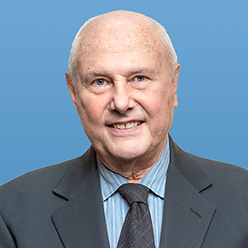
April 24, 2026 - AFPC Chairman of the Central Asia-Caucasus Institute S. Frederick Starr quoted in Eurasianet. [link]
The ongoing standoff in the Strait of Hormuz between the United States and Iran is forcing a rethink about regional energy and trade routes. Afghanistan is a potential lynchpin of a new route that circumvents the Hormuz choke point, but Taliban control of the country calls into question Kabul’s viability as a connector to global markets.
Afghanistan’s willingness and ability to participate in emerging energy and trade networks was a hotly debated topic among regional experts during a recent day-long discussion on Capitol Hill in Washington organized by the New Lines Institute for Strategy and Policy (NLI). The event was held under the auspices of NLI’s Central Asia Center, which has developed the Silk Seven Plus (S7+) initiative, a concept envisioning the creation of a Greater Central Asian economic community and the emergence of a robust trade crescent stretching from the Caspian Basin to the Arabian Sea.
Participants acknowledged that Afghanistan was the “gorilla in the room” in terms of turning the S7+ concept into reality. Myriad obstacles exist to constructing pipelines, railroads and other infrastructure in Afghanistan, including the Taliban’s toleration of radical Islamic militant groups, the government’s discriminatory domestic policies, the bitter legacy of the 20-year US military presence in the country and simmering conflict between the Taliban and Pakistan.
Despite the present challenges, S. Frederick Starr, a leading American expert on the region and founder of the Central Asia-Caucasus Institute, argued vociferously that Afghanistan needs to be woven into the fabric of a Greater Central Asia to unlock the region’s full trade potential in critical minerals, fossil fuels and other goods.
Starr said Central Asian states are already working assiduously and “subtly” to bring Afghanistan into the fold, adding “all of them have de facto recognized” the Taliban’s leadership of the country. He noted Uzbekistan’s annual trade turnover had already reached about $1.5 billion with Afghanistan and was set to grow rapidly in the coming years, adding that slow progress was being made on the construction of a trans-Afghan natural gas pipeline intended to connect Turkmenistan to Pakistan and India.
The US approach, Starr added, should be to ‘stay out of the way’ and let Central Asian states manage relations with Afghanistan themselves.
“Afghanistan desperately wants to be part of Greater Central Asia,” Starr said. “Reality is much more dynamic and textured, and things happening, than we acknowledge.”