| Publications By Category |
| Publications By Type |
|
Articles Books In-House Bulletins Monographs Policy Papers |
| Archive |
| Results 11 |
Pages << 1 >> |
Results per page - 10 - 20 - |
| AFPC CHINA BRIEF: China's Central Party School: A Primer |
| Joshua Eisenman, August 2012 |
|
The Central Party School of the Communist Party of China’s Central Committee (CCPS), established in 1933 in Ruijin, Jiangxi and now located in Beijing’s western suburbs, is the most important institution in China’s midcareer official training system. It is China’s premier facility and educational institution for the training of medium and high-ranking Communist Party of China (CPC) cadre from across the country including ministers, provincial Party chiefs and governors. Between 1977 and 2010, over 60,000 officials (including some who are not CPC members) were trained at the CCPS. The CCPS assists cadre from across the country and different ministries and Party organizations to form new and closer relationships, take time from their busy schedules to learn from past experiences, and functions as a policy think-tank and a theoretical research institute for the Politburo Standing Committee, the CPC’s highest policymaking body. Top CPC leaders have always served as CCPS presidents, including Mao Zedong, Liu Shaoqi, Hua Guofeng, Hu Jintao, Zeng Qinghong and now Xi Jinping. |
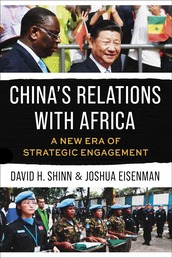
| China and Africa: A Century of Engagement |
| Amb. David H. Shinn and Joshua Eisenman, University of Pennsylvania Press, June 2012 |
|
|
| Iran Strategy Brief No. 5: Iran's Venezuelan Gateway |
| Norman A. Bailey, February 2012 |
|
For years, the media and the U.S. government have repeated a familiar refrain: that the regime of now-ailing Venezuelan strongman Hugo Chavez, however annoying, poses no serious threat to the national security of the United States. Compelling evidence, however, suggests otherwise. Under Chavez, Venezuela has systematically opposed U.S. values and initiatives throughout the Western Hemisphere and the world in general. It has tried to influence political events in other Latin American countries, sometimes successfully. It has supported guerrilla movements and terrorist organizations in other countries (most notably Colombia). And it has facilitated the activities of drug traffickers active in the region, even as it has destabilized the regional status quo through massive military purchases. |
| Iran Strategy Brief No. 4: Hezbollah's Inroads Into The Western Hemisphere |
| Ilan Berman, August 2011 |
|
A year after the attacks of September 11th, then-Deputy Secretary of State Richard Armitage, in contextualizing the terrorist threat facing the country, made a telling assessment. “Hezbollah may be the A-team of terrorists,” Mr. Armitage told an audience at the United States Institute of Peace in Washington, DC, “and maybe al-Qaida is actually the B-team.” The description was apt, and remains so. With a presence in an estimated forty countries on five different continents, the Lebanese Shi’ite militia represents one of the very few terrorist groups active today that possess a truly global presence and reach. |
| Toward An Economic Warfare Stategy Against Iran |
| Report of the American Foreign Policy Task Force, June 2010 |
|
America's strategy toward Iran is faltering. Nearly seven years after the disclosure of the Iranian regime’s nuclear program, and a year-and-a-half after the start of “engagement” on the part of the Obama administration, Washington has yet to see a substantive diplomatic breakthrough in the deepening international impasse over the Iranian regime’s nuclear ambitions. To the contrary, mounting evidence suggests that Iran’s rulers have used the strategic pause aff orded by American outreach to forge ahead with their nuclear endeavor, adding permanence to Iran’s increasingly mature and menacing atomic effort. |
| Winning The Long War: Retaking The Offensive Against Radical Islam |
| Ilan Berman, Rowman and Littlefield Publishers, July 2009 |
|
Winning the Long War is a trenchant examination of the past seven years of the Global War on Terror, the future battlegrounds that will confront the United States in the struggle against radical Islam in the years ahead, and how America can reclaim the initiative in what has become the defining struggle of the twenty-first century. |
| Taking On Tehran: Strategies For Confronting The Islamic Republic |
| Ilan Berman, Editor, Rowman and Littlefield Publishers, March 2007 |
|
Taking on Tehran provides concrete solutions to the emerging Iranian global threat. With contributions from leading analysts and practitioners, Taking on Tehran examines the various approaches - economic, political and military - that can be taken by the United States and its allies to confront and defeat the contemporary challenge posed by the Islamic Republic. It offers practical, achievable guidance to policymakers and unique insight for students into how foreign policy is really made. |
| Dismantling Tyranny: Transitioning Beyond Totalitarian Regimes |
| Ilan Berman and J. Michael Waller, Editors, Rowman and Littlefield Publishers, December 2005 |
|
Dismantling Tyranny is the first significant study of how new democracies handled the legacy of the secret police of the previous totalitarian regimes. It contains chapters that study the cases of the Czech Republic, Estonia, the former East Germany, Lithuania, Nicaragua, Poland and Russia. This isn't just a history book, however. In the words of the publisher, "it is a guidebook designed to empower, inform, and guide future transitions toward democracy for those political leaders with the initiative and courage to embark upon such a visionary path." |
| Tehran Rising: Iran's Challenge to the United States |
| Ilan Berman, Rowman and Littlefield Publishers, September 2005 |
|
Today, Iran constitutes the single greatest challenge to the United States and the War on Terror. In the Persian Gulf and Central Asia, Iranian policymakers are busy cobbling together alliances intended to marginalize the United States and its Coalition allies. Iran remains the world's most active sponsor of terrorism, fueling the activities of Hezbollah, al-Qaeda, and insurgents in Iraq. And, through its nuclear advances, Iran is gaining the capability to catastrophically alter the geopolitical balance of power far beyond its immediate neighborhood. |
| Reviving Greater Russia? The Future Of Russia's Borders With Belarus, Georgia, Kazakhstan, Moldova And Ukraine |
| Herman Pirchner, Jr., University Press of America, June 2005 |
|
In December 2001, a new Russian law laying the basis for the peaceful territorial expansion of the Russian Federation went into effect. The entire country of Belarus-as well as parts of Georgia, Kazakhstan, and Ukraine-are the most likely candidates to join Russia. Should this largely ethnically-based expansion occur, Russia would grow by more than 20 million people, and the resultant rise in Russian nationalism might encourage further Russian territorial ambitions-especially those directed at Ukraine. Even if Russian expansion stops with all, or part, of these territories, however, it could breathe new life into the ethnically based border problems of other countries. A timely and prescient work, made all the more relevant by Russia's invasion of Georgia in August 2008. |
| Islam, Islamism and the West: The Divide Between Ideological Islam and Liberal Democracy |
| Caroline Cox and John Marks, American Foreign Policy Council, March 2005 |
|
The vast majority of Muslims word-wide are peaceable, law-abiding and hospitable people. Nevertheless, the West's reaction to atrocities such as 9/11 and 7/7, and the lack of a coherent understanding of our adversaries, is threatening relations with all Muslims. In Islam, Islamism and the West, British experts Baroness Caroline Cox and Dr. John Marks offer an exploration of the ideological roots of militant Islamism, and outline the challenge that it poses for Western societies at large. |
| Results 11 |
Pages << 1 >> |
Results per page - 10 - 20 - |